
.svg)
.svg)

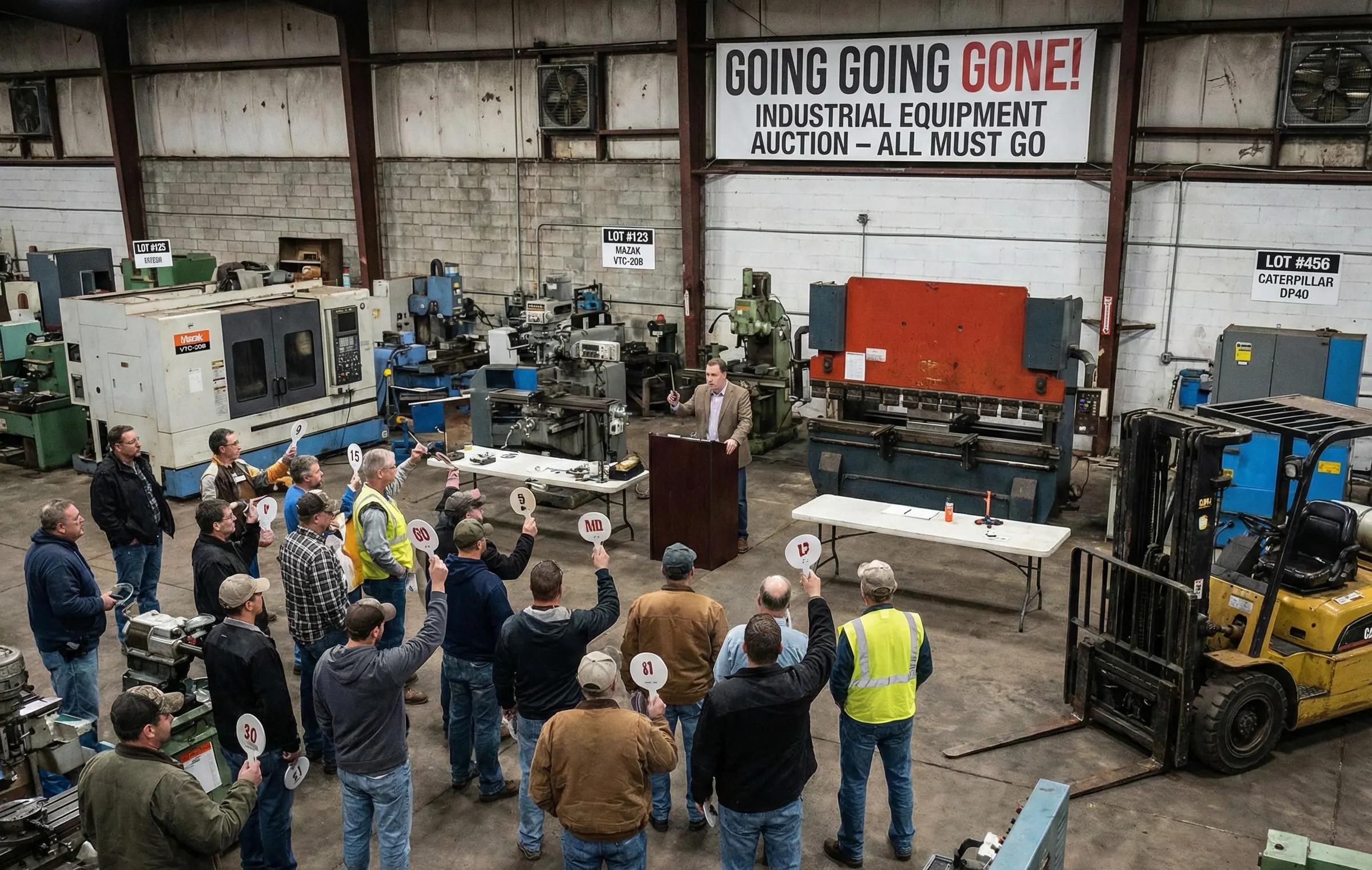
Equipment Auctions as Early Indicators for Industrial Real Estate
The U.S. industrial economy in 2024 and 2025 sits at an unusual crossroads. Record manufacturing investment, strong reshoring momentum, and hundreds of thousands of new jobs coexist with cooling activity in core industrial operations. This shift has brought equipment auctions into focus—not as isolated events, but as leading indicators of where industrial real estate demand is headed next.
Holland Industrial Group closely tracks this relationship between asset auctions and space utilization to help owners, occupiers, and investors anticipate changes in demand before they fully show up in vacancy and absorption statistics.
Manufacturing Investment vs. Operational Moderation
Manufacturing construction spending climbed to an unprecedented $238 billion in 2024, driven by reshoring and foreign direct investment. Companies announced more than 244,000 new U.S. jobs tied to these initiatives, underscoring long-term confidence in domestic production.
At the same time, actual manufacturing activity cooled mid-year as high interest rates curbed demand. Many firms chose to optimize their operations and balance sheets instead of expanding aggressively. That shift in strategy is one of the main reasons equipment auctions have become so active—and so informative about the next phase of industrial real estate demand.
Auction Trends and Market Dynamics
Used equipment flooded the auction market in 2024, marking a sharp reversal from the shortage-driven environment of 2021 and 2022. Year-over-year inventory increases were substantial across key categories:
- Heavy-duty trucks: approximately 14% increase in available inventory.
- Semitrailers: roughly 45% inventory growth year-over-year.
- Medium trucks and construction machinery: notable gains as operators rebalanced fleets and project pipelines.
This surge put downward pressure on auction pricing and signaled a shift in corporate behavior. Logistics, construction, and manufacturing firms sold surplus or older assets to raise cash, fund upgrades, or rebalance their operating footprints. Rather than reflecting broad distress, these auctions point to an economy moving from expansion at any cost toward a more disciplined, efficiency-driven posture.
Used Equipment Inventory Change by Category (Mar 2024)
For industrial real estate, auction volume has become a leading signal. The same companies that sell trucks, forklifts, and machinery frequently reduce warehouse or factory footprints soon after. In 2024, as auction activity accelerated, U.S. industrial vacancy climbed toward 7%, while net absorption fell to roughly 65 million square feet—a steep drop from the record highs logged in 2021.
What Auction Activity Reveals by Sector
Looking at which assets are being liquidated—and why—provides insight into how individual sectors are repositioning for the next cycle.
Transportation & Logistics
Transportation and logistics equipment saw the steepest increase in auction supply, tracking freight slowdowns and fleet consolidations. Many operators are trimming excess capacity and tightening network efficiency after years of elevated volume.
Construction Machinery
Construction equipment auctions largely reflect a normalization in activity. As project pipelines steadied from earlier peaks, contractors used auctions to right-size fleets rather than exit markets altogether.
Manufacturing & Automation
In manufacturing, auctions often signal technology upgrades. Companies are selling older CNC machines and robotics systems to finance more advanced automation, shifting their cost structure and productivity profile without necessarily expanding square footage.
Taken together, these patterns depict an industrial economy evolving toward higher efficiency and automation rather than broad-based contraction.
Southeast Spotlight: Reshoring’s Front Line
The Southeast remains a standout region for manufacturing expansion, capturing around 60% of all new reshored jobs in 2024. Major electric-vehicle and battery plants from Georgia through Tennessee continue to drive facility demand and long-term hiring commitments.
While warehouse markets such as Atlanta are still digesting heavy construction completed in 2021 and 2022, vacancy remains moderate and long-term fundamentals are solid. Manufacturing centers like Greenville and Huntsville are experiencing tight conditions, with limited available space and growing demand from advanced manufacturing, automotive, and aerospace users.
Regional Share of New Manufacturing Jobs (Reshoring/FDI, 2024)
Outlook and Strategic Implications
Auction data and industrial absorption trends continue to move together. The 2024 spike in equipment liquidations likely marked the peak of this normalization phase. With used equipment prices stabilizing and several categories already rebounding, the stage is being set for industrial real estate to stabilize and gradually strengthen.
According to leading market outlooks, the U.S. economy is positioned for growth in 2025 and beyond, with industrial leasing activity expected to remain steady and cap rates projected to compress slightly. As real estate demand firms up, companies with surplus equipment today will likely begin redeploying assets into new or expanded facilities.
U.S. Industrial Net Absorption by Year
Overall, the industrial landscape appears to be entering a period of balance. As supply and demand even out, both the equipment market and industrial real estate are positioned to rise together. Auctions and asset turnover should be read not as symptoms of decline, but as part of a healthy reset that enables sustainable growth in the years ahead.
%20(1).jpg)