.svg)
.svg)

%20(1).jpg)
HIG Industrial Transition Insights
Closing or Relocating a Manufacturing Plant Is Complicated. Managing the Transition Doesn’t Have to Be.
How an integrated strategy for plant closure, equipment liquidation, environmental management, facility cleanout, and industrial real estate can preserve value, reduce risk, and relieve the burden on ownership.
Executive summary. A manufacturing plant closure is not a single transaction. It is a coordinated industrial transition involving workforce obligations, equipment appraisal and liquidation, market outreach, safety, environmental risk, facility decommissioning, cleanout, and real estate disposition. Ownership should understand the major decisions, but it should not have to become the auctioneer, rigger, environmental coordinator, scrap processor, demolition contractor, and broker. Holland Industrial Group places those workstreams under one accountable strategy—using specialized execution to reduce stress, protect net recovery, and return the property to productive use.
- Asset appraisal
- Auctions & private sales
- Rigging, cleanout & scrap
- Environmental coordination
- Real estate repositioning
By the time a company decides to close or consolidate a manufacturing facility, management is usually already handling employee communications, production transfers, customer commitments, lenders, suppliers, and community relationships. The physical plant creates another major project on top of that pressure. Machines must be secured and valued. Utilities and hazardous energy must be controlled. Environmental obligations must be understood. Buyers and contractors need safe access. The building must be protected, cleaned, and positioned for sale, lease, or reuse.
For covered employers and qualifying events, the federal WARN Act generally requires 60 days of advance written notice for a plant closing or mass layoff, subject to statutory definitions and exceptions. State requirements may add separate obligations, which is one reason the closure strategy should be established before the final production run rather than after it.1
The central challenge is not finding vendors. There are capable auctioneers, appraisers, environmental consultants, riggers, recyclers, demolition contractors, and industrial brokers in the market. The challenge is making sure their decisions support the same outcome. Without an integrated plan, ownership becomes the project manager for a highly specialized, time-sensitive transition—and every vendor naturally optimizes only its own assignment.
The Real Risk Is Fragmented Execution
A plant closure can involve several different businesses operating inside the same building at the same time. An auctioneer may be focused on sale proceeds. A rigger may be focused on removing sold assets quickly. A scrap processor may be focused on recoverable material. An environmental consultant may be defining the scope of a condition. A broker may be trying to preserve infrastructure for a future user. Each objective can be reasonable on its own, yet the facility can still lose value if no one is coordinating the whole project.
For example, removing a crane, substation, compressed-air system, racking package, or wastewater improvement may produce immediate cash, but it may also narrow the pool of manufacturers willing to occupy the building. Delaying equipment removal may improve sale pricing but jeopardize a property closing. Beginning demolition before environmental work is properly sequenced can create unnecessary cost or regulatory complications. These are not vendor-quality problems. They are coordination problems.
HIG approaches the assignment as one industrial transition. Ownership receives one accountable team, one master schedule, one view of the budget, and one coordinated decision process. That does not mean a generalist performs every technical task. It means HIG organizes the appropriate specialists under a single strategy, manages the interfaces between them, and remains responsible for the overall result. The objective is one point of accountability without sacrificing the quality of specialized execution.
The Difference Is Coordination
A plant closure may require many specialists. The critical question is who owns the combined outcome.
Fragmented Model
Ownership becomes the project manager—while each vendor optimizes only its own assignment.
Integrated HIG Model
One Point of Accountability
Specialized workstreams coordinated by HIG
- Asset appraisal
& disposition - Rigging, scrap
& cleanout - Environmental
coordination - Real estate
repositioning - Reporting, safety
& final handoff
One coordinated strategy. Specialized execution.
Figure 1. Fragmented execution forces ownership to coordinate every specialist. The integrated model places those specialties under one accountable strategy.
A Plant Closure Is a Net-Recovery Project
The success of a plant liquidation should not be measured by gross auction proceeds alone. The more useful measure is net facility recovery: the value produced or preserved across equipment, scrap, infrastructure, and real estate after accounting for rigging, freight, environmental work, repairs, carrying costs, and delay.
That broader calculation changes the decision-making process. A machine expected to sell for a high price may require expensive crane work, specialized transportation, wall or roof openings, and subsequent building repair. A production line with a narrower external buyer pool may have substantial value to an incoming operator. A low-value component may still be worth removing because it creates clean, flexible space. HIG evaluates those tradeoffs at the facility level rather than allowing one sale result to dictate the entire strategy.
HIG’s published asset-disposition process includes in-depth asset review, data-driven valuation, customized sale methods, strategic outreach, transaction management, and post-sale coordination. HIG also reports a buyer network of more than 400,000 bidders, expanding exposure well beyond the immediate local market.2,3
The Right Metric Is Net Facility Recovery
Maximizing one auction result can reduce the value of the overall transition.
Value created or preserved
for the next user
sale or lease value
Facility
Recovery
Costs and value leakage
and remediation
and carrying costs
decision-making
HIG evaluates the entire facility—not just gross auction proceeds—so equipment, environmental, timing and real estate decisions support the same financial objective.
Figure 2. Total facility recovery incorporates both value creation and value leakage. The best equipment decision is the one that improves the overall outcome.
Equipment Is an Asset Strategy, Not Just a Removal Task
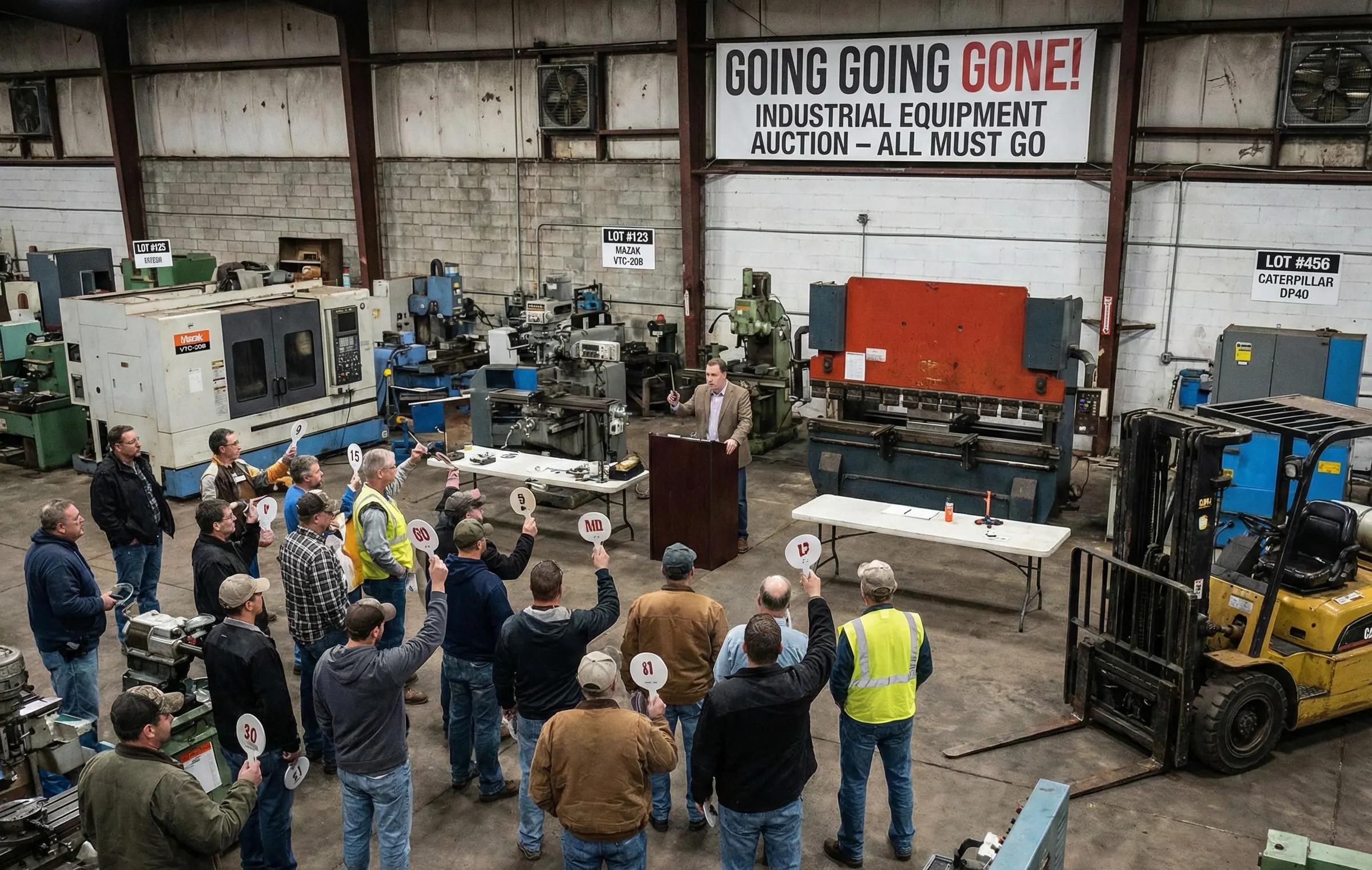
Equipment disposition is one of the most visible parts of a factory shutdown, but the goal is not to empty the building as quickly as possible or to sell every item through the same channel. The goal is to determine the right strategy for each asset while protecting the schedule and the value of the property.
HIG inventories and appraises machinery, tooling, material-handling equipment, maintenance assets, spare parts, racking, electrical infrastructure, cranes, compressors, generators, laboratory equipment, vehicles, and recoverable scrap. From there, assets may be sold by auction or private treaty, relocated to another company facility, retained with the property, recycled, or managed through an approved disposal process. The choice depends on market demand, net recovery after removal, deadlines, safety, environmental requirements, and value to the next user—not simply the highest theoretical sale price.
Removal planning is equally important. OSHA’s lockout/tagout standard requires an orderly shutdown and control of hazardous energy during servicing and maintenance, and it requires the on-site employer and outside servicing employers to inform one another of their respective energy-control procedures. HIG’s role is to coordinate qualified contractors, access rules, insurance, utility disconnects, rigging plans, floor and roof protection, buyer deadlines, and final restoration so the sale does not create a new operational or real estate problem.4
Time Is a Financial Variable, Not Just a Scheduling Issue
Every additional month a closed plant remains unresolved can add property taxes, insurance, security, utilities, property management, interest, weather exposure, vandalism risk, building deterioration, and lost rent. In many cases, a slightly higher asset price is not a better result if it extends the schedule enough to create larger carrying costs or delay the property’s next use.
Fragmented projects often move sequentially: first the appraisal, then the auction, then equipment removal, then environmental work, then building repairs, then real estate marketing. An integrated transition moves the workstreams in parallel. Asset inventory can occur while environmental records are being reviewed. Equipment can be marketed while building specifications and real estate materials are prepared. Repairs can be sequenced with removals, and potential users can be consulted before useful infrastructure is sold. This is how HIG reduces dead time without reducing diligence.
Integrated Workstreams Reduce Dead Time
Illustrative workflow—actual timing depends on workforce obligations, permits, equipment and environmental conditions.
The integrated model begins real estate, environmental and asset work in parallel. A fragmented model waits for one vendor to finish before the next begins—extending vacancy and carrying costs.
Figure 3. An integrated transition overlaps governance, safety, asset, environmental, and real estate workstreams. Actual timing varies by facility and legal requirements.
Environmental Complexity Should Be Managed, Not Feared
Environmental uncertainty is one of the greatest sources of stress in an industrial facility closure. Historical manufacturing operations may involve tanks, solvents, oils, metals, process wastewater, pits, sumps, drains, waste-storage areas, asbestos-containing materials, polychlorinated biphenyls, refrigerants, or other conditions that affect cleanup, financing, insurance, and reuse. The issue is not merely whether a property has an environmental history. The issue is whether the risk has been defined, priced, and placed on an executable path.
HIG coordinates the environmental workstream with qualified professionals and regulatory stakeholders. That can include collecting historical records, reviewing permits and manifests, supporting a Phase I Environmental Site Assessment, coordinating targeted investigation where necessary, defining remediation or risk-management options, managing approved removal and disposal, and assembling the documentation needed for a buyer, tenant, lender, or agency. EPA recognizes ASTM E1527-21 as consistent with the federal All Appropriate Inquiries process for evaluating environmental conditions and potential liability in commercial property transactions.5
EPA’s Brownfields Road Map emphasizes that site investigation, cleanup, and reuse planning should be understood as a connected process. That principle is particularly important at closed manufacturing plants: the intended future use can influence investigation priorities, remedy selection, sequencing, and the infrastructure that should be retained. Separate Resource Conservation and Recovery Act closure requirements may also apply to hazardous-waste management units or certain generator operations, which is why environmental and regulatory work should begin early rather than after the building has been emptied.6,7
HIG’s value in environmentally complicated assignments is not a promise that every condition is simple. It is the ability to take ownership of the coordination problem, bring the right professionals into the process, connect the cleanup strategy to the real estate plan, and keep the owner from managing environmental, equipment, and property decisions in separate silos. Properly managed environmental complexity can become a defined business issue rather than an open-ended source of fear.
The Real Estate Strategy Begins Before the Last Asset Leaves
The next use of the building should influence the closure from the beginning. A former manufacturing plant may be more attractive than a generic warehouse because it already contains power, reinforced floors, cranes, wastewater capacity, rail access, compressed air, outdoor storage, or other infrastructure that would be expensive and time-consuming to reproduce. If those assets are removed before the market is tested, the property can lose the feature that made it valuable to the next operator.
HIG begins preparing the industrial real estate strategy while equipment and environmental work are underway. The team can assemble building specifications, utility information, zoning and survey materials, environmental documentation, repair scopes, photographs, and reuse scenarios while the facility is being cleared. That allows marketing, buyer outreach, tenant discussions, and site preparation to move together rather than forcing the property to sit idle after the liquidation is complete.
HIG demonstrated this coordinated approach in Fort Smith, Arkansas. According to the company’s May 2026 announcement, HIG acquired a 147,000-square-foot industrial facility on 5.65 acres after the prior occupant closed, oversaw the equipment liquidation and removal logistics, prepared the site, and sold the property to Dynamic Food Ingredients in under 60 days. The incoming company’s planned reuse was expected to support approximately 100 jobs. The lesson is not that every plant can transition in two months. It is that equipment disposition, site work, and real estate execution can materially reduce downtime when they begin under one strategy.8
HIG Case Study: Fort Smith, Arkansas
A coordinated acquisition, equipment liquidation, site preparation and sale.
147,000 SF
industrial facility
Under 60 Days
acquisition-to-sale cycle
~100 Jobs
expected from the
next operator
The lesson is not that every plant can transition in 60 days. Integrated decision-making can materially reduce downtime between operators.
Source: HIG press release, May 4, 2026
Figure 4. HIG’s Fort Smith transaction illustrates how coordinated equipment and real estate execution can shorten the gap between operators.
One Point of Accountability, Without Sacrificing Quality
A one-stop industrial transition partner should not mean one company attempting to perform every specialty at a superficial level. The better model is integrated project control supported by qualified technical execution. HIG establishes the strategy, scope, budget, reporting cadence, schedule, safety expectations, approval process, and turnover standard, then coordinates the appropriate appraisers, auction professionals, riggers, environmental specialists, recyclers, demolition crews, contractors, and real estate professionals around that plan.
HIG’s published capabilities cover asset appraisal and disposition, facility evaluations, full-scale cleanouts, scrap and demolition, regulatory coordination, transaction management, and real estate solutions. HIG reports more than 40 years of experience and more than 4 million square feet of industrial real estate under ownership or operation. Those capabilities allow HIG to manage both the physical complexity of the plant and the financial objective behind the transition.2,3,9,10
For ownership, the practical benefit is a smaller management burden and a clearer chain of responsibility. Instead of reconciling conflicting vendor schedules, reviewing several isolated budgets, and determining which contractor is responsible for a gap, the owner has one team accountable for the combined result. That structure improves communication, reduces the chance that one workstream damages another, and preserves executive attention for employees, customers, and the company’s broader strategic decisions.
The owner should understand the major decisions. It should not have to become the auctioneer, rigger, environmental coordinator, recycler, demolition contractor, and broker to get through a plant closure.
What a Successful Plant Transition Looks Like
A successful manufacturing plant closure is not simply an empty building. It is a safe, documented, and financially optimized transition. Employees and stakeholders are handled professionally. Valuable equipment reaches the right market. Removal occurs without unnecessary damage or delay. Environmental obligations are defined and addressed. Useful infrastructure is preserved when it supports the next user. The facility is delivered in an agreed condition, and the real estate returns to productive use as efficiently as possible.
That outcome requires more than a machinery auction or a property listing. It requires an integrated view of equipment, environmental risk, facility condition, time, and real estate. HIG’s role is to take the operational burden off ownership while protecting the quality of each specialty, maximizing practical net recovery, and keeping the transition moving toward a clear final result.
Sources and Further Reading
- [1] U.S. Department of Labor, WARN Advisor: notice requirements for plant closings and mass layoffs.
- [2] Holland Industrial Group, About: company experience, bidder network, and real estate platform.
- [3] Holland Industrial Group, Asset Disposition & Acquisition: appraisal, valuation, customized disposition, and transaction management.
- [4] Occupational Safety and Health Administration, 29 CFR 1910.147: control of hazardous energy and contractor coordination.
- [5] U.S. Environmental Protection Agency, Brownfields All Appropriate Inquiries: ASTM E1527-21 and environmental due diligence.
- [6] U.S. Environmental Protection Agency, Brownfields Road Map: investigation, cleanup, and reuse planning.
- [7] U.S. Environmental Protection Agency, hazardous-waste generator and facility closure requirements.
- [8] PR Newswire, Holland Industrial Group’s Fort Smith acquisition-to-sale case study, May 4, 2026.
- [9] Holland Industrial Group, Facility & Asset Management: cleanouts, scrap handling, decommissioning, and regulatory coordination.
- [10] Holland Industrial Group, Industrial Demolition, Decommissioning & Scrap Services: full-scope project control and final turnover.
Important: This article provides general planning information and is not legal, environmental, tax, labor, engineering, or safety advice. Site-specific obligations should be reviewed with qualified professionals and the appropriate authorities.